How Does the Internet Travel Under the Ocean?
Discover how submarine fibre-optic cables connect continents and carry data across the world's oceans.
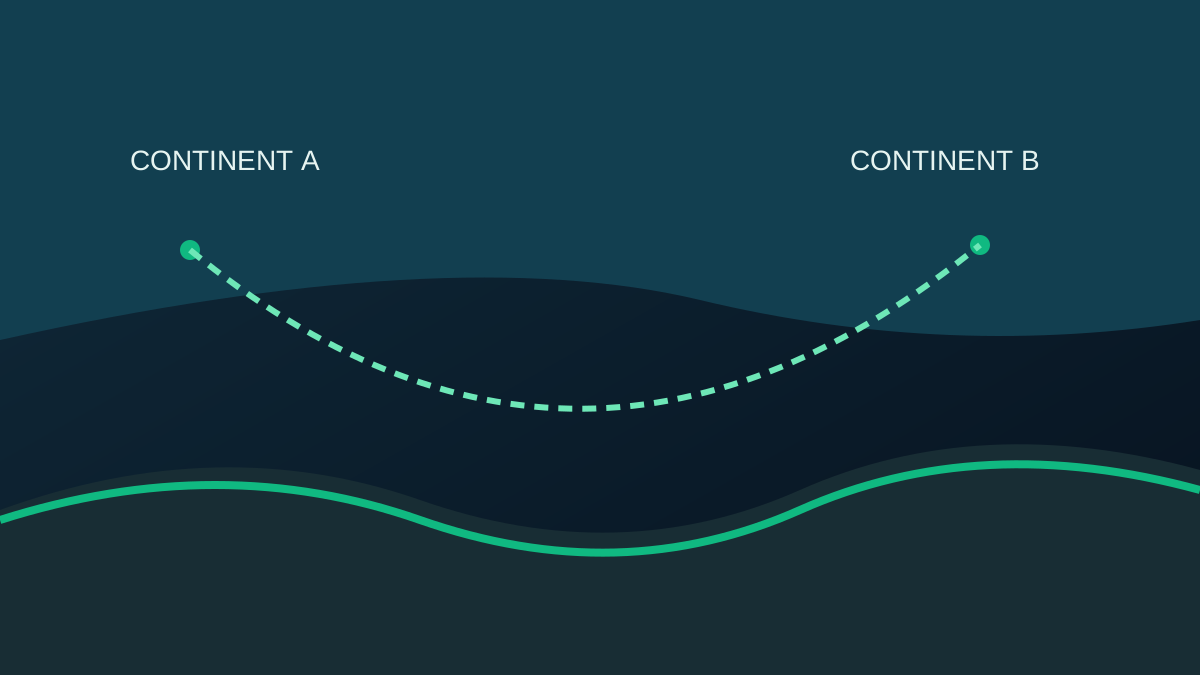
When you send a message to someone on another continent, some of the data may travel through a cable resting on the ocean floor.
These submarine telecommunications cables are a major part of the global internet’s physical infrastructure. They carry enormous volumes of data between countries and continents.
Why use cables under the sea?
Radio links and satellites are useful for some communications, but fibre-optic cables offer very high capacity and low latency over long distances. For many intercontinental routes, undersea fibre is the practical backbone.
How do fibre-optic cables carry data?
Fibre-optic systems transmit information using pulses of light through very thin strands of glass. At the receiving end, equipment converts the optical signals back into data.
A cable system includes more than the cable itself. It also uses terminal equipment, power-feeding equipment and, on long routes, optical amplifiers or repeaters.
How are cables installed?
Specialized cable ships carry large quantities of cable and carefully lay it along planned routes. Near coastlines, cables may be buried beneath the seabed to reduce the risk of damage from anchors and fishing activity.
The route is surveyed in advance to avoid hazards where possible.
What happens if a cable is damaged?
A cable fault can interrupt or reduce capacity on a route. Network operators may reroute traffic through other available systems, although the result can be higher latency or congestion.
Repair ships locate the fault, recover the cable and splice in a replacement section. Repairs depend on location, weather and the nature of the damage.
Are satellites replacing submarine cables?
Satellites provide important connectivity, especially in remote areas and for mobile applications. But submarine fibre systems remain crucial for high-capacity intercontinental traffic.
Different technologies serve different needs; the global internet depends on a combination of terrestrial fibre, undersea cables, wireless links and satellites.
The takeaway
The internet is not purely virtual. It depends on physical infrastructure that engineers plan, install, power, monitor and repair—including thousands of kilometres of cable beneath the sea.
Stay curious. Keep exploring.